


0571-26692003
No. 181 Geyazhuang, Xihu District,Hangzhou, Zhejiang, P.R. China

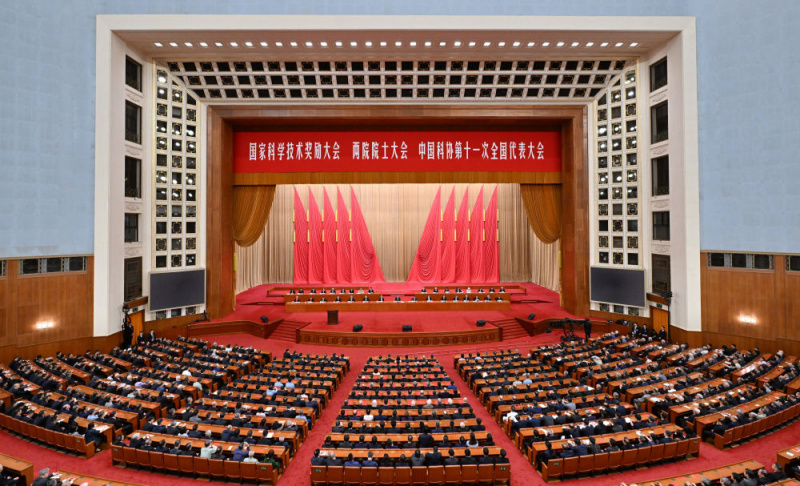
Source | Xinhua News Agency
On July 8, the National Science and Technology Award Conference, the General Assemblies of the Chinese Academy of Sciences and the Chinese Academy of Engineering, and the 11th National Congress of the China Association for Science and Technology were held in Beijing. The results of the 2025 National Science and Technology Awards were officially announced. The research achievement titled "Nuclear Quantum Effects on Hydrogen-Bond and Dynamics of Water" received the First Prize of the National Natural Science Award. The work was completed by Peking University as the contributing institution, with Enge Wang, Member of the Chinese Academy of Sciences, Chair of the Academic Committee of the Institute of Physics at the Chinese Academy of Sciences, Chair of the Academic Committee at the Tsientang Institute for Advanced Study (TIAS), as the lead principal investigator, and Professors Ying Jiang, Xinzheng Li, Limei Xu, and Yiqin Gao of Peking University as co-principal investigators.
The National Natural Science Award is conferred upon scientists and technologists who have made significant discoveries in basic research and applied basic research. The First Prize is one of the highest honors in China's natural science basic research field. The awarded achievements typically possess characteristics such as being previously undiscovered or unexplained, carrying substantial scientific value, and receiving broad recognition from the domestic and international scientific community. It represents a major national commendation for original innovation and breakthroughs in basic research.
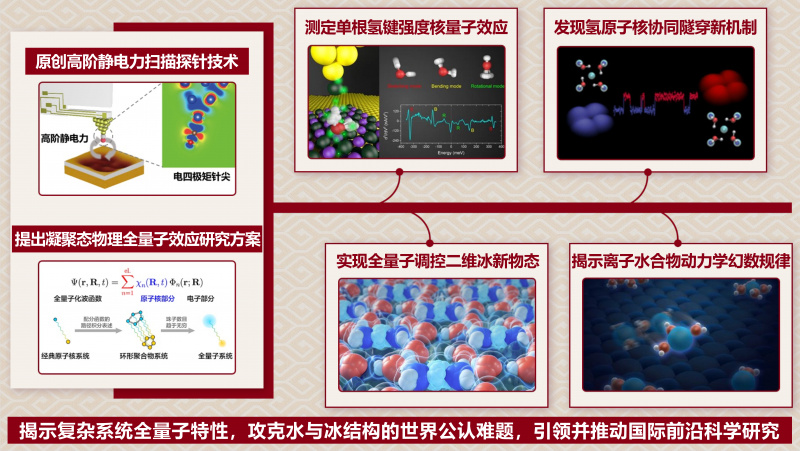
The research achievement "Nuclear Quantum Effects on Hydrogen-Bond and Dynamics of Water", led by Academician Enge Wang and his team, addresses fundamental scientific questions concerning the complex system of "water". Starting from the basic physical laws of the microscopic world and building on over two decades of research, the team established a physical research framework that goes beyond the Born–Oppenheimer approximation, enabling a full quantum description of both electronic and nuclear degrees of freedom. They pioneered a high-order electrostatic force microscopy capable of resolving individual hydrogen atoms, achieving a leapfrog development in developed advanced instrumentation. For the first time, they precisely determined the strength of a single hydrogen bond, discovered universal laws of nuclear quantum effects and the mechanism of concerted proton tunneling, and realized new states of matter through the manipulation of nuclear quantum effects. This achievement reveals the full quantum properties of complex systems, resolves the globally recognized challenge of the structure of water and ice, and has spearheaded advancements in the frontier scientific research.
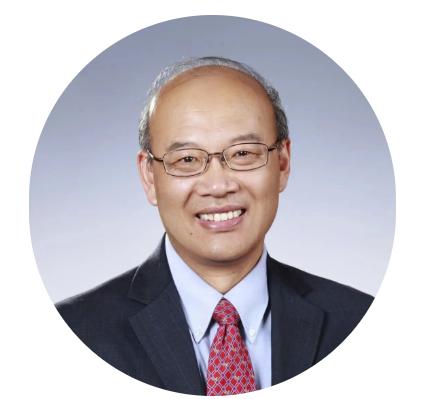
Enge Wang is a Member of the Chinese Academy of Sciences, Chair of the Academic Committee of the Institute of Physics at the Chinese Academy of Sciences, and Chair of the Academic Committee at the TIAS. From 1999 to 2021, he served as Director of the Institute of Physics at the Chinese Academy of Sciences, Director of the Beijing National Laboratory for Condensed Matter Physics, President of Peking University, and Vice President of the Chinese Academy of Sciences and Director of the Division of Mathematics and Physics. He also serves as Executive Vice President of the International Union of Pure and Applied Physics (IUPAP), First Chairman of the Global Cooperation Alliance of Science Centers, and International Director of the American Physical Society (APS).
His primary research interests focus on new states and properties of light-element materials beyond the Born–Oppenheimer approximation. He has published over 360 academic papers (including more than 20 in Science and Nature, and over 70 in Nature journals and Physical Review Letters), and has authored three monographs in both Chinese and English. He has received numerous prestigious honors, including the Humboldt Research Award (Germany), the TWAS Prize in Physics, the Achievement in Asia Award from the International Organization of Chinese Physicists and Astronomers (OCPA), the Tan Kah Kee Science Award in Mathematics and Physics, the Ho Leung Ho Lee Science and Technology Progress Award, the Second Prize of the National Natural Science Award (twice), and the China Publishing Government Award.
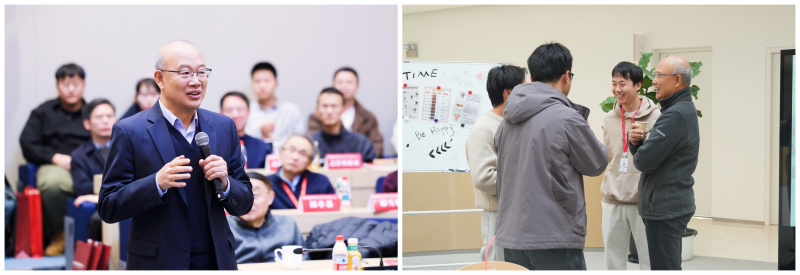
As Chair of the Academic Committee at TIAS, Academician Enge Wang guides the Institute’s disciplinary development, academic planning and international cooperation and exchange, playing a vital role in clarifying academic orientations, refining disciplinary layouts and gathering high-end resources for TIAS. In March 2025, Academician Enge Wang founded the "Tsientang Lectures" and delivered the inaugural lecture, helping TIAS build a high-level platform for intellectual exchange and enrich the academic environment. He remains deeply engaged in frontline scientific research. He not only mentors young scholars in research directions and team building face-to-face, but also interacts closely with students, leading by example and inspiring the younger generation to explore boldly and pursue innovation with rigorous scholarly standards.
The First Prize of the National Natural Science Award is a well-deserved recognition of the long-term commitment and relentless pursuit of scientific excellence by Academician Enge Wang and his team. We extend our sincere congratulations to them! We also offer our highest respect to all researchers who remain steadfast in their dedication, pursue knowledge with perseverance, and strive for innovation.


